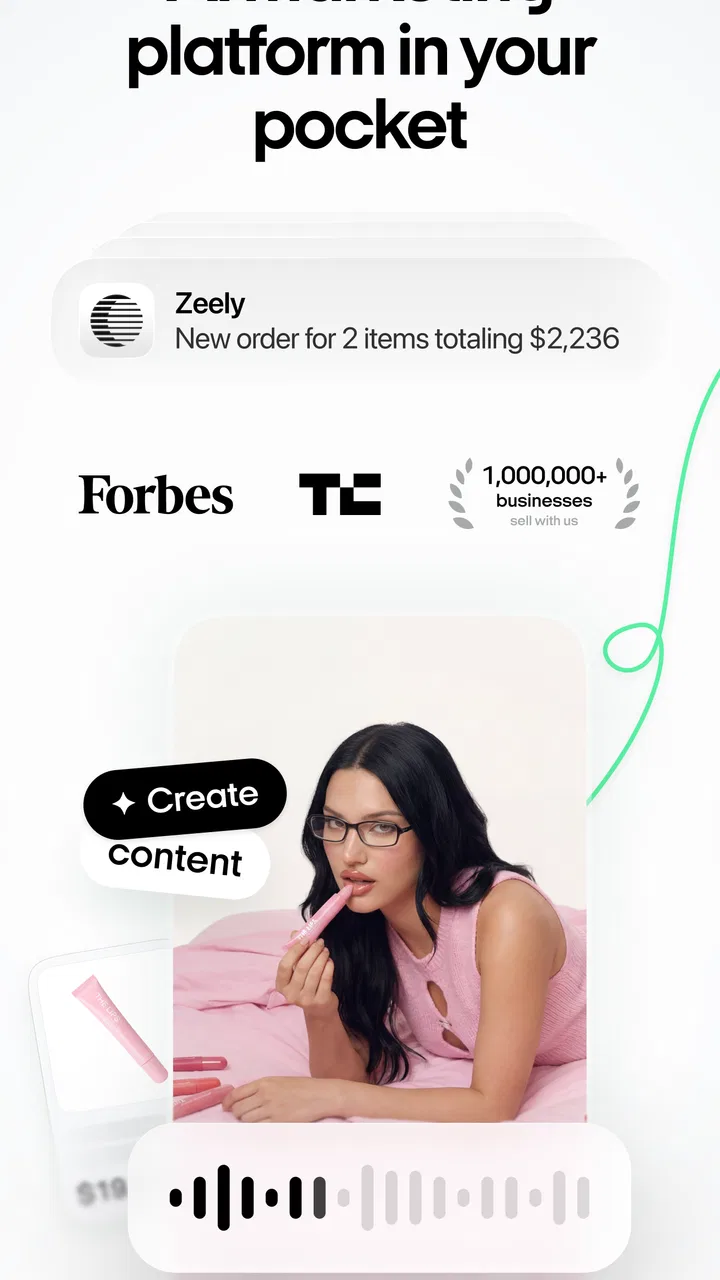
Zeely: AI Marketing Platform
- 4.3
- Rating
- 100.00K
- Installs
- Free
- Price

 Analysis by App-foxy
I approached Zeely as a practical productivity app for people who need to move from a rough business idea to regular marketing activity without assembling a large collection of separate tools. Its promise is attractive: create content, prepare campaigns, and keep a brand moving from one place. After spending time with that workflow, my view is clear: it is most useful for a small business owner or solo creator who needs structure and speed, but it is less convincing for an experienced marketer who wants deep control over every campaign detail.
The important distinction is that this is not simply a writing app with a few promotional extras. The experience is built around marketing momentum. Instead of opening one tool for captions, another for planning, and another for campaign preparation, I could think about the business goal first and then work outward toward content. That change in starting point matters when the real problem is not a lack of ideas, but the difficulty of turning those ideas into something consistent.
How Zeely fits into a real marketing routine
I use a simple test when deciding whether a marketing app belongs in my routine: does it help me turn a real business goal into a next step, or does it just give me another place to collect drafts? That distinction shapes how I approach Zeely, especially when time is limited and the campaign idea is still rough. It also helps clarify which parts of a marketing workflow are worth keeping together—and which may be better handled elsewhere.
You May Also Like

 Blood Strike: 2.5 Anniversary
Blood Strike’s Loadouts Turn Every Drop Into a Tactical Gamble
A close look at Blood Strike’s custom loadouts: how fast access to signature weapons reshapes its battle royale rhythm, rewards preparation, and narrows the gap between fights.

 Pandora - Music & Podcasts
Pandora’s Music Is Easy to Start, but Harder to Recover
Pandora’s strength is its low-effort path from a seed to a station. Its weak spot is how much confidence it asks you to place in connection, setup, and quiet recovery.

 8 Ball Pool
 Is Built on Rivalries, Rematches, and Routine
A close look at the rivalries, rematches, shared routines, and unanswered safety questions that turn a quick pool match into a persistent mobile community.

 Samsung Music
’s Quiet Strength Is Playing What You Already Own
Its reach comes less from spectacle than from dependable access to a personal library. That simplicity is both the app’s strongest retention engine and its ceiling.

 AccuWeather: Weather Radar
AccuWeather Review: A Quick, Clear Forecast for Everyday Decisions
For everyday plans, the best forecast is the one you can understand quickly. AccuWeather makes rain timing, radar, and local conditions easy to act on, with a few trade-offs.

 Hill Climb Racing
Why Hill Climb Racing Still Turns Crashes Into One More Run
A tiny car, a bumpy hill and one more upgrade: Hill Climb Racing keeps resurfacing because its simple chaos makes every near-miss feel personal.
More From Our News Desk
View All News


A useful starting point for an unfinished idea
Many small brands do not begin with a polished marketing brief. They begin with a product, a service, a seasonal offer, or a vague feeling that their online presence needs attention. The strongest part of Zeely is the way it encourages that unfinished thought to become an organized marketing task. I found this more approachable than opening a blank document and trying to decide whether I needed a social post, an advertisement, a landing-page message, or a full campaign first.
That makes the app especially practical for people who are close to their customers but not confident in marketing language. A local tutor, independent beauty professional, home-based seller, or small online shop can start with what they actually want to promote rather than learning a complete marketing system before taking action. The app’s value is therefore partly creative and partly psychological: it reduces the hesitation that often stops a small business from publishing anything at all.
I would not describe the workflow as a replacement for marketing judgement. It gives direction and helps generate usable material, but I still had to decide whether the wording sounded like the business, whether the offer was genuinely clear, and whether the intended customer would understand the next step. That is a healthy division of labor. The app can help produce a first version; the owner still needs to provide the local knowledge and final sense check.
Where the content workflow feels strongest
The most convincing use case is repeated content creation. A single post is rarely the real challenge. The harder task is maintaining a recognizable voice while finding fresh angles for the same product or service. Zeely is better suited to that ongoing problem than a basic notes app because it keeps the marketing purpose in view while content is being developed.
For example, imagine I run a small meal-preparation service and want to promote a new weekly menu. I could begin with the menu itself, then shape messages around convenience, dietary flexibility, preparation quality, and ordering urgency. The useful insight is not merely that the app can help write those messages. It is that I can treat them as parts of one campaign rather than four unrelated posts. That makes the result feel more deliberate and gives me a better chance of avoiding repetitive “buy now” wording.
I also found that a short planning pause before generating anything leads to better results. I would write down the audience, the single action I wanted people to take, and the one proof point that made the offer credible. That small preparation prevents generic copy. It is one of the less obvious lessons of using an AI marketing platform: the quality of the output depends heavily on the quality of the business context supplied at the beginning.
Another practical strength is repurposing. A business owner may have one useful idea but lack the time to adapt it for different moments in the customer journey. A product introduction, an explanation of how it works, a reminder, and a follow-up message should not all sound identical. Zeely makes that kind of variation easier to plan than starting from an empty screen every time. I still edited the wording, but I spent more time choosing the angle and less time wrestling with the first sentence.
Campaign thinking instead of isolated posts
The campaign side is where the app can become more valuable than a conventional caption generator. A caption tool usually answers a narrow question: what should I write for this post? Zeely is aimed at a wider question: how do I turn this business objective into a sequence of marketing actions? That broader perspective is useful for people who tend to publish sporadically and then wonder why the results feel disconnected.
I would use it by defining one modest objective at a time. For a new service, that might mean first explaining the problem, then showing the service’s practical benefit, then addressing a common objection, and finally inviting people to make contact. This is more realistic for a small business than trying to design an enormous launch plan. It also creates a simple way to judge the work: every piece should support the same objective, even if the wording and format change.
A particularly useful trade-off is that the app encourages speed over exhaustive customization. That is good when the alternative is doing nothing, but it means I would not hand over every decision to the platform. A campaign can be coherent and still be wrong for a particular audience. Local expressions, regulated claims, pricing details, delivery limits, and customer sensitivities need a human review. The faster the draft arrives, the more important that review becomes.
What the numbers suggest about its position
Zeely, Inc. is the developer behind this productivity app, which is available free of charge with optional in-app purchases ranging from $4.99 to $199.99 per item. That pricing structure makes the first step relatively easy, but it also means I would examine the upgrade path carefully before building a workflow around features that may require payment. A free starting point is helpful for testing the experience; it should not be mistaken for an unlimited marketing service.
The app has an average rating of 4.3 from around 7.9 thousand ratings, with more than a thousand written reviews and over 100 thousand installs. Those figures suggest that it has attracted a meaningful audience without making popularity a substitute for personal fit. I would treat the response as encouraging, particularly for a focused tool aimed at small businesses, while still judging it by whether its workflow matches my own needs.
It is rated for Everyone, which makes the presentation approachable for a broad audience. The current version is 8.7.0, and the app requires Android 10 or later. That operating-system requirement is worth checking before planning to use it on an older phone. On a supported device, the practical question is not whether the app can be opened, but whether its guided approach saves enough time compared with the tools I already understand.
The meaningful weakness: convenience can become sameness
My main reservation is the risk of polished but interchangeable marketing. AI-assisted content can sound fluent while saying very little. If I accepted the first suggestion every time, my brand could end up using familiar promotional language that lacks the specific details customers remember. This is not a flaw unique to Zeely, but it matters more here because the app is designed to make content production feel easy.
The solution is not complicated, although it requires discipline. I would add concrete details that only the business knows: the neighborhood served, the material used, the time saved, the common customer concern, the reason a process works, or the small service habit that earns repeat business. I would also remove any sentence that sounds impressive but does not help a customer decide. In my experience, the platform works best as a fast first-draft partner, not as an automatic brand voice.
There is a second limitation for advanced users. Someone who already works comfortably with detailed audience segmentation, testing plans, conversion tracking, and tightly controlled brand guidelines may find a guided all-in-one experience less flexible than specialized tools. A dedicated writing system can offer more control over tone and editing; a dedicated advertising platform can provide deeper campaign settings; a spreadsheet or project manager can make custom planning easier. Zeely’s advantage is the connection between these activities, so its compromises are most visible when depth in one area matters more than convenience across several.
I also would not choose it as the only tool for a business with strict approval procedures. If every claim must pass through several people, or if content needs extensive legal and brand review, the speed of generation is less important than traceability and control. In that situation, the app may still help with early ideas, but a more formal content-management process would be safer for final production.
Three workflows that make the app more useful
My first recommendation is to build a small message bank before creating a campaign. I would prepare a few customer questions, a few proof points, and a few phrases that reflect the owner’s natural way of speaking. Then I would use those ingredients as a filter for every draft. This produces more distinctive content than asking for “a professional post” with no context, and it makes editing much faster because I know what must remain true.
The second is to separate awareness content from action content. A post explaining a customer problem should not use the same pressure as a direct offer. I would create one group that teaches or clarifies, another that demonstrates the product or service, and a final group that asks for a specific action. This prevents a feed from becoming a continuous string of sales messages and gives the campaign a more believable rhythm.
The third is to reuse a campaign only after reviewing its performance in plain language. Even without turning the app into a full analytics operation, I can ask simple questions: did people understand the offer, did they ask the intended question, and did the message attract the right type of inquiry? If the answer is no, I would revise the audience or the promise before generating more variations. Producing additional content cannot fix a confused offer.
A fourth useful habit is to keep the final editing pass on a separate checklist. I would verify names, prices, availability, timing, claims, contact instructions, and the exact action requested. This is particularly important for small businesses because one incorrect detail can create customer frustration that no attractive wording can repair. The app makes drafting quicker; it does not remove the need for operational accuracy.
Who will get the most from it
I think Zeely is a strong match for a solo entrepreneur who knows the business well but does not have a dedicated marketing employee. It can also suit a very small team that needs a shared starting point for content and campaign ideas without investing immediately in several specialist subscriptions. The best candidates are people who want to publish more consistently, need help organizing their thoughts, and are willing to edit AI-generated material before it reaches customers.
It is also useful for someone launching a new offer and feeling overwhelmed by the number of messages required. The app can help break that launch into understandable stages instead of treating marketing as one large, vague task. I would especially recommend testing it during a short, clearly defined promotion. That gives the user a concrete objective and makes it easier to decide whether the workflow saves time.
I would be more cautious about recommending it to a professional marketer who already has a mature system. If that person needs granular control, extensive collaboration, advanced reporting, or a highly specialized advertising workflow, separate tools may be the better choice. The same applies to a business whose success depends on highly original editorial content rather than practical promotional communication. In those cases, Zeely may help with brainstorming, but it is unlikely to replace the specialist setup.
Everyday usability and the cost decision
The free entry point makes sense for a trial, especially if I approach it with one real business task rather than browsing without a goal. I would test whether the app can help me produce a coherent set of messages, whether the editing time is genuinely lower, and whether the resulting language sounds like my business. Only after that would I consider an in-app purchase. The wide range between the lowest and highest listed item prices means the value calculation depends heavily on the particular plan or feature being offered at the time.
For occasional users, paying may not be worthwhile. Someone who needs one announcement every few months could manage with a general writing tool and a simple content calendar. The app becomes easier to justify when marketing is a weekly responsibility and the cost of scattered tools, lost time, and unfinished ideas is already noticeable. In other words, the purchase decision should be based on workflow frequency, not on the appeal of having an AI label attached to the process.
Because the app is in the productivity category, I would also set a boundary around its role. It should help me make decisions and drafts faster, not encourage me to fill every day with content. A smaller number of specific, useful messages can be more valuable than a large volume of vague ones. The platform is at its best when it supports a clear business objective rather than becoming a machine for constant posting.
My final recommendation
After using it as a marketing companion, I see Zeely as a practical bridge between having something to sell and having a repeatable way to talk about it. Its strongest quality is not any single generated sentence. It is the way it brings content and campaign thinking closer together, which can help a busy owner stop treating marketing as a series of disconnected emergencies.
The limitations are equally important. I would not publish drafts without checking facts, tone, and originality, and I would not expect the app to provide the depth of a specialist marketing stack. The free download is a sensible way to judge the fit, while the in-app purchase range means I would make the upgrade decision only after identifying a specific problem the paid option solves.
My recommendation is therefore focused rather than universal: try it if you run a small brand, need regular promotional material, and want guidance without building a complicated system from scratch. Skip it, or use it only for early ideas, if you already have advanced campaign tools or require unusually precise control. For the right user, Zeely can turn marketing from an intimidating blank page into a manageable routine. Its real strength is helping you move from intention to organized action, provided you keep your own judgement in charge.
FAQs for Zeely: AI Marketing Platform
01What is Zeely: AI Marketing Platform, and who is it designed for?
Zeely is an AI-powered marketing platform aimed primarily at small businesses, entrepreneurs, freelancers, and creators who want to promote products or services without building every campaign manually. It can help with tasks such as creating marketing content, preparing promotional materials, and organizing campaign ideas. The app is most useful for users who need guided tools and templates rather than a fully customized agency-level marketing solution.
02Can Zeely create a complete marketing campaign for my business?
Zeely can assist with important parts of a marketing campaign, including generating content ideas, writing promotional copy, and helping structure advertising or social media materials. However, users should not expect the app to replace a professional marketing team entirely. Campaign quality depends on the information you provide, your chosen audience, and how carefully you review and adapt the AI-generated recommendations before publishing them.
03Is Zeely free to download and use?
The app may be available to download at no initial cost, but some features, tools, or usage limits can depend on a subscription or in-app purchase. Before starting a trial or entering payment details, check the current pricing, renewal terms, and cancellation policy shown in the relevant app store. Availability of free features and subscription plans may also vary by country and platform.
04Is Zeely suitable for beginners with no marketing experience?
Zeely is generally designed to be approachable for beginners because it provides guided workflows, AI assistance, and ready-made suggestions instead of requiring users to start with a blank page. Even so, some basic understanding of the business, target customer, offer, and preferred communication style is helpful. Beginners should carefully proofread generated text and verify that claims, prices, and contact details are accurate.
05What should I consider before using AI-generated content from Zeely?
AI-generated marketing content can save time, but it should be treated as a draft rather than automatically publishable material. Review every caption, advertisement, product description, and recommendation for accuracy, tone, originality, and compliance with advertising rules. Avoid entering confidential customer information or sensitive business data unless the platform’s privacy policy clearly explains how that information is stored and processed.
Pros
- AI creates marketing content quickly
- saving time for small businesses.
- Includes ready-to-use templates for social posts
- ads
- and promotions.
- Helps maintain a consistent brand voice across marketing materials.
- Useful guidance makes digital marketing easier for beginners.
- Can support campaign planning without requiring a marketing specialist.
Cons
- AI-generated copy may need editing to match your brand and audience.
- Some advanced tools and content options may require a paid subscription.
- Results depend heavily on the quality of information you provide.
- Automated suggestions may feel generic for highly specialized businesses.
- Frequent marketing use can consume credits or increase subscription costs.

Zeely: AI Marketing Platform
Gallery